

The front of a kids’ omega-3 bottle is designed to sound simple. The back label is where parents find the details that decide whether a product is age-fit, realistic, and worth comparing. Once you know how to read kids’ omega-3 supplement labels, the small print becomes less of a maze and more of a quick filter.
Health-related decisions such as choosing supplement amounts, using omega-3 alongside medications, or managing allergy concerns should be handled with a qualified pediatric clinician to align with your child’s needs and applicable medical standards.
What to know first
A kids’ omega-3 label has three main jobs: it tells you what omega-3s are included, how much your child gets per serving, and what else comes with that serving. The label does not prove that a product will deliver a specific health outcome, no matter how confident the front-of-bottle wording sounds.
The fastest label read starts with the Supplement Facts panel, then moves to directions, other ingredients, allergen statements, storage instructions, and testing or freshness notes. That order keeps you focused on usable facts instead of flavor names and marketing badges.
- Start with DHA and EPA amounts, not the total fish oil number.
- Check the serving size before comparing products.
- Identify the source: fish oil, algal oil, cod liver oil, or another marine source.
- Read other ingredients for sweeteners, colors, gelatin, and allergens.
- Treat broad claims as marketing unless the label gives clear, relevant detail.
DHA, EPA, and “total omega-3” are not the same thing
DHA and EPA are the omega-3 fatty acids most parents are usually trying to compare on kids’ supplement labels. “Total omega-3” can include DHA, EPA, and sometimes other omega-3 fats, so it is not always a clean substitute for the individual DHA and EPA lines.
For example, a label might list 500 mg of fish oil but a smaller amount of DHA and EPA. That does not automatically make the product bad; it simply means the fish oil amount is not the number to use when comparing meaningful omega-3 content. Look for “DHA per serving” and “EPA per serving” inside the Supplement Facts panel.
Many labels do not show a % Daily Value for DHA or EPA because a Daily Value is not established for those individual fatty acids. That blank space is common and should not be read as a warning by itself. If you want a broader choosing framework after reading the panel, our guide to choosing the best omega-3 supplement for kids walks through format, source, and family-fit tradeoffs together.
The serving size is where labels get slippery
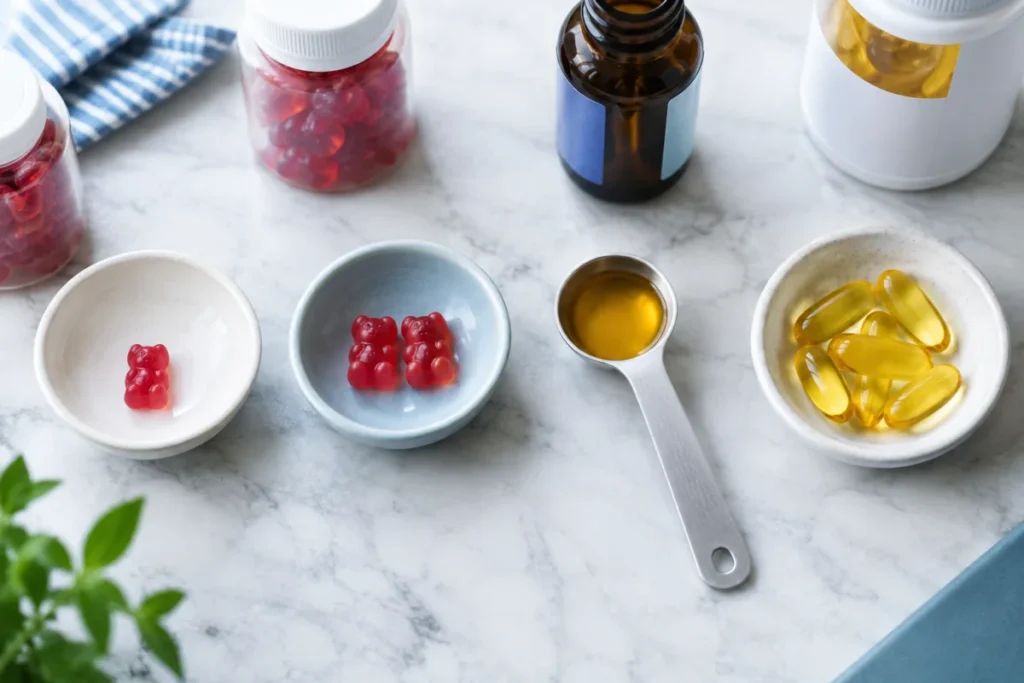
Serving size is the quiet troublemaker on kids’ omega-3 labels. One product may list nutrients for one gummy, another for two gummies, another for a teaspoon of liquid, and another for several chewable softgels. If you compare the front claims without checking serving size, you may be comparing a single chew to a full daily serving.
Read the serving size and directions together. A Supplement Facts panel may say “per serving,” while the directions may specify an age range, frequency, or whether the product should be taken with food. Age-fit belongs to the manufacturer’s labeling and your child’s real ability to manage the format, not just the cute design on the bottle.
A quick serving-size check
- Find the serving size at the top of the Supplement Facts panel.
- Check how many gummies, softgels, teaspoons, or packets make one serving.
- Look at DHA and EPA per serving, not per container.
- Compare servings per container if value matters for siblings or daily use.
- Confirm the labeled age range before assuming it fits your child.
Fish oil, algal oil, and cod liver oil need different label checks
The omega-3 source affects dietary fit, allergen concerns, taste expectations, and sometimes which omega-3s are present. Fish oil is common in liquid, softgel, and chewable formats. Algal oil is a fish-free source often used in vegan or vegetarian-positioned products. Cod liver oil is a distinct fish-derived product that may also contain vitamins A and D, so its label deserves an extra look rather than being treated as ordinary fish oil.
Do not assume “plant-based” means the same thing across products. Some plant oils provide ALA, which the body handles differently than DHA and EPA. If the goal is to compare DHA and EPA, the label needs to list those amounts directly.
If source type is your first filter, the Kids Omega-3 Format Finder can help you sort options by format, omega source, flavor style, storage style, and age-stage fit without turning the kitchen table into a spreadsheet.
Other ingredients explain the daily friction
The “Other Ingredients” list is where you find the parts that affect taste, texture, and household acceptance. Gummies may include sugars, syrups, pectin or gelatin, flavors, colors, and acids for tartness. Liquids may include flavoring, antioxidants, or emulsifiers. Softgels may use gelatin and glycerin. None of these details tells you whether your child will like the product, but they help you avoid obvious mismatches.
For families managing dietary preferences or restrictions, this section matters as much as the omega-3 panel. Check for fish, shellfish, gelatin source, soy, coconut, gluten statements, and any facility or cross-contact language provided by the manufacturer. Allergen statements vary in how much detail they give, so do not rely on front labels like “natural” or “clean” to answer allergy questions.
Testing, freshness, and storage: small details with real-world consequences
Omega-3 products can be sensitive to heat, air, and time. The label may mention third-party testing, quality certifications, purity testing, freshness, expiration date, lot number, or storage instructions. These are not decorative extras; they help you judge whether a product gives enough transparency for your comfort level.
Third-party testing language is strongest when it names the testing organization or clearly explains what is tested, such as contaminants or oxidation markers. Vague phrases like “quality tested” are less useful because they do not tell you who tested it or what standard was used.
Storage instructions also deserve attention before purchase. A shelf-stable gummy may fit a pantry routine, while some liquids may require refrigeration after opening. If the bottle needs to live in the fridge but your family only remembers supplements at the breakfast cabinet, that mismatch can become the reason the routine quietly dies. Labels are not just science; sometimes they are a prediction of where the bottle will be forgotten.
Claims that sound stronger than the label can prove
Kids’ omega-3 products often use structure-and-function style language, such as support for brain, eye, or general wellness. These statements are not the same as proof that a supplement will create a measurable result for an individual child. A responsible label read separates the claim from the facts underneath it.
Ask three questions when you see a bold claim:
- Does the label list DHA and EPA amounts clearly?
- Is the claim tied to a nutrient that is actually present in a meaningful, visible amount?
- Does the wording promise an outcome, or does it use broader “supports” language?
Be especially careful with claims that imply behavior, school performance, mood, or development. Those are health and developmental areas where supplement labels should not be treated as personalized guidance.
Common label-reading mistakes
- Mistaking “fish oil” milligrams for DHA and EPA milligrams.
- Comparing one gummy to a two-gummy serving.
- Ignoring the age range because the flavor seems child-friendly.
- Overlooking added sugars, gelatin, or allergens in the other ingredients list.
- Assuming fish-free means DHA-free, or assuming plant-based always means DHA and EPA are listed.
- Buying a refrigerated liquid when the family routine only works with shelf-stable options.
- Treating front-label wellness claims as stronger evidence than the Supplement Facts panel.
A simple label-reading routine
Use the same order every time and the process gets faster. First, confirm the age range and serving size. Second, find DHA and EPA per serving. Third, identify the omega source. Fourth, scan other ingredients and allergens. Fifth, check testing, freshness, expiration, and storage. Last, decide whether the format has a realistic chance of working in your actual week.
That final step is not a throwaway. A technically impressive product that your child refuses, or that has to be stored somewhere nobody looks, is not practical value. Once you have chosen a product that passes the label check, use a simple habit cue. Our tips for making kids’ omega-3 part of a daily routine can help turn the bottle from “good intention” into something the family actually remembers.
Common questions
Is higher total omega-3 always better?
Not necessarily. Total omega-3 can include different fatty acids, and serving size can vary widely. Compare DHA and EPA per labeled serving first, then consider age fit, ingredients, and routine practicality.
Should I choose fish oil or algal oil?
That depends on dietary fit, allergen concerns, product format, and the DHA and EPA amounts listed on the label. Fish oil and algal oil can both appear in children’s products, but the label should tell you exactly what source and amounts are included.
What does “molecularly distilled” mean on a fish oil label?
It generally refers to a processing method used by some manufacturers. The more useful parent check is whether the label or brand information clearly explains testing for contaminants, freshness, or quality, rather than relying on one technical phrase alone.
What stands out
The best label readers do not memorize every supplement term. They follow a steady checklist: serving size, DHA, EPA, source, other ingredients, allergens, testing, freshness, storage, and claims. That is enough to spot most meaningful differences before spending money or starting a routine.
For parents, the goal is not a perfect label. It is a product whose facts are clear, whose format fits your child, and whose routine demands are realistic. The back of the bottle will usually tell you whether that is likely long before the first serving becomes a breakfast-table negotiation.